Author: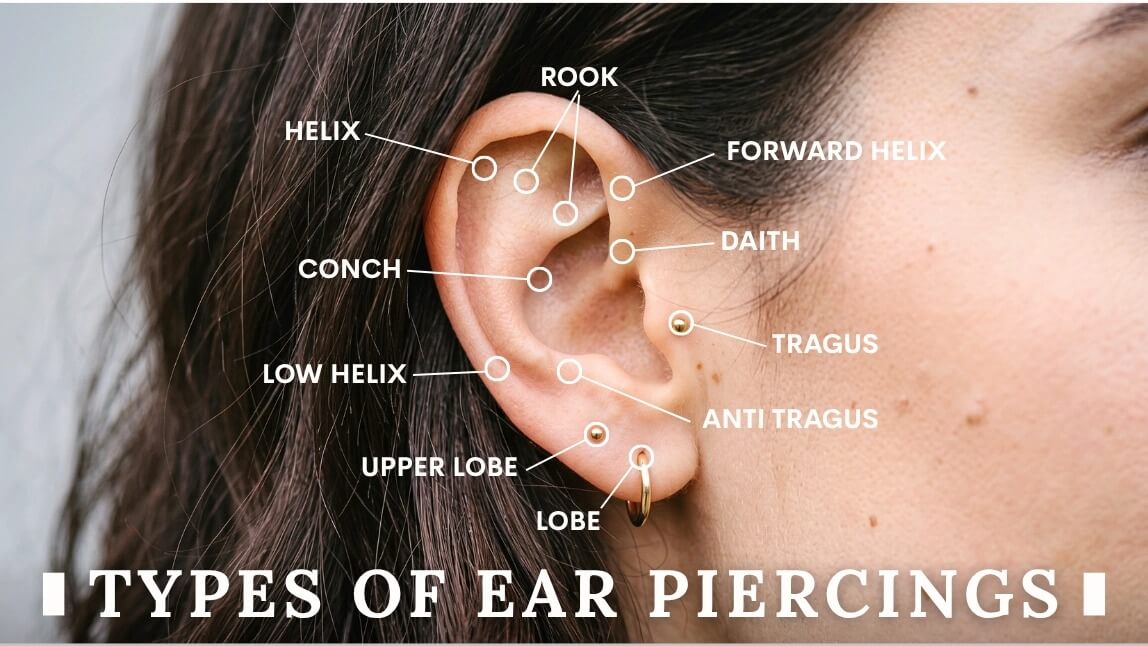
Disclaimer: Some images in this article may have been created or modified by AI
There are roughly sixteen recognized types of ear piercings, and almost nobody can name more than five of them out loud. Lobe, helix, tragus, done. Meanwhile your piercer is casually asking whether you want a flat or a rook, and you are nodding like you know the difference.This guide fixes that. Every ear piercing type, mapped by anatomy, ranked by pain, timed by healing, and matched to the jewelry that actually fits it. We also cover the part most charts skip: not every ear can take every piercing, and the fastest way to find out which ones suit yours is to see them on your own ear before a needle gets involved. AI powered virtual try-on has quietly become the planning step between "I want more piercings" and "I booked an appointment," and for jewelry brands it has become one of the highest converting tools on a product page.
Table of Contents
- Can You See Every Piercing Type on Your Own Ear First?
- What Are the Main Types of Ear Piercings?
- What Are the Lobe Piercing Types?
- What Are the Outer Cartilage Piercing Types?
- What Are the Inner Cartilage Piercing Types?
- Which Ear Piercings Hurt the Most?
- How Long Does Each Ear Piercing Take to Heal?
- How Do You Build a Curated Ear Stack?
- How Much Do Ear Piercings Cost?
- What Jewelry Works Best for Each Piercing Type?
- What Happens at an Ear Piercing Appointment?
- What Are the Ear Piercing Trends Right Now?
- Which Ear Piercing Should You Get Next?
- How Do Jewelry Brands Use Virtual Try-On for Piercing Decisions?
- FAQ: Types of Ear Piercings
Can You See Every Piercing Type on Your Own Ear First?
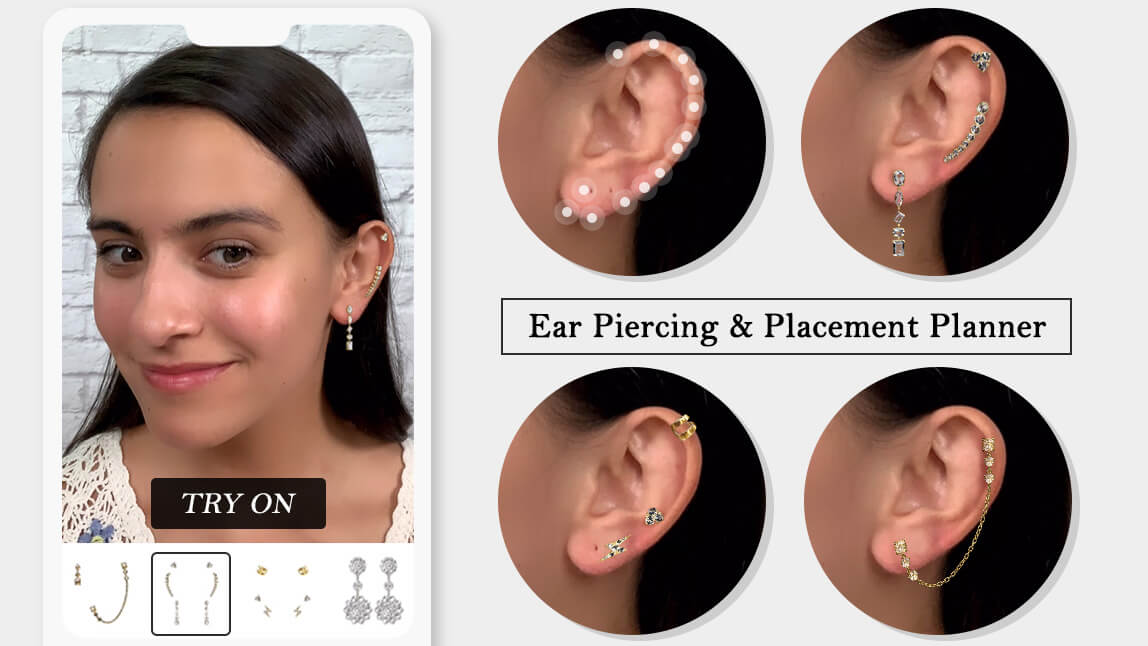
Plan your ear in real time: open the free ear piercing simulator and test every placement in this guide on your own ear before you book.
Yes, and it takes about ten seconds. This is the single most useful thing you can do before booking, because a piercing chart shows you a generic ear while you have a very specific one.
Perfect Corp's free virtual earring try-on and ear piercing simulator uses real time AR to render jewelry onto your live camera feed. You can stack a helix with a conch, swap a stud for a huggie, test how a daith ring reads at your ear's angle, and screenshot the combinations you like to show your piercer. No commitment, no swelling, no eight month regret.
Three things it answers that a flat chart cannot:
- Scale. A 10mm hoop looks delicate on one ear and enormous on another. You only learn which by seeing it on yours.
- Spacing. Curated ears live and die by the gaps between pieces. AR shows you the rhythm before it is permanent.
- Metal tone. Yellow gold, white gold and rose gold read completely differently against your skin tone, and against each other in a stack.
Use it as a planning tool, then keep reading for the anatomy that decides what is actually possible on your ear.
What Are the Main Types of Ear Piercings?
Ear piercings fall into three anatomical groups: lobe piercings through soft tissue, outer cartilage piercings along the rim, and inner cartilage piercings in the folds and ridges near the ear canal. Each group has a different pain profile, a different healing timeline, and a different jewelry vocabulary.

| Piercing Type | Location | Pain (1 to 10) | Healing Time | Starter Jewelry |
|---|---|---|---|---|
| Standard lobe | Soft lower lobe | 2 | 6 to 8 weeks | Flat back stud |
| Upper lobe | Above the standard hole | 2 to 3 | 6 to 10 weeks | Flat back stud |
| Third lobe | Highest point of soft lobe | 3 | 8 to 12 weeks | Small stud |
| Transverse lobe | Horizontally through the lobe | 4 | 2 to 4 months | Curved or straight barbell |
| Helix | Upper outer rim | 4 to 5 | 3 to 6 months | Labret stud |
| Forward helix | Front of the rim, near the face | 5 | 3 to 9 months | Flat back stud |
| Flat | Flat cartilage plateau inside the rim | 5 to 6 | 4 to 12 months | Labret stud |
| Industrial | Two holes joined by one bar | 7 to 8 | 6 to 12 months | Straight barbell |
| Auricle | Mid outer rim, between lobe and helix | 4 | 3 to 6 months | Stud or small hoop |
| Tragus | Small flap over the ear canal | 5 | 3 to 6 months | Flat back stud |
| Anti-tragus | Ridge opposite the tragus | 6 to 7 | 4 to 12 months | Curved barbell |
| Inner conch | Center bowl of the ear | 5 to 6 | 4 to 12 months | Labret stud |
| Outer conch | Outer edge of the same bowl | 5 to 6 | 4 to 12 months | Stud or large hoop |
| Daith | Innermost fold above the canal | 6 | 4 to 12 months | Clicker or seamless ring |
| Rook | Thick fold above the daith | 7 | 6 to 12 months | Curved barbell |
| Snug | Inner ridge, mid ear | 8 | 6 to 12 months | Curved barbell |
Ear Anatomy in Plain English
Piercing names come from anatomy, so five terms unlock the entire vocabulary:
- Lobe: the soft fleshy bottom, the only part of the ear with no cartilage in it.
- Helix: the curved outer rim that runs from the top of the ear down toward the back.
- Concha: the deep bowl in the middle of the ear, which the conch piercing is named after.
- Tragus: the small flap of cartilage that partly covers the opening of the ear canal.
- Antihelix: the inner ridge that runs parallel to the outer rim, and the structure that makes the rook and snug possible or impossible.
Once those five are clear, the rest of the names explain themselves. Forward helix is the front of the rim. Anti-tragus is the ridge opposite the tragus. Daith is the fold at the start of the helix, deep inside the ear. The naming is logical, which is a relief given how much of the rest of piercing culture is not.
Pain numbers are averages reported across piercing studios and community surveys. Your tolerance, your anatomy and your piercer's technique all move the number, sometimes by two points in either direction.
What Are the Lobe Piercing Types?
The lobe is soft tissue with no cartilage, which is why it heals fastest and hurts least. It is where almost every ear journey starts, and where most people stop.
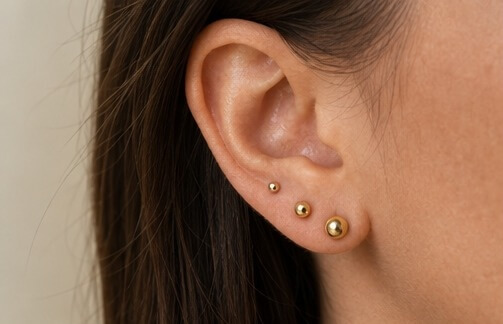
Standard Lobe
The classic. Centered in the fleshy part of the lobe, healed in six to eight weeks, and the only piercing most studios will do on a young child. Pain sits around a 2 out of 10, closer to a firm pinch than a sting.
Upper and Third Lobe
Stacked above the standard hole, usually 5 to 8mm apart. Placement matters more than people expect, because uneven spacing is obvious in every photo forever. This is one of the placements where seeing the stack rendered on your own lobe before committing saves the most grief.
Transverse Lobe
Runs horizontally through the lobe rather than front to back, so a barbell appears to float across it with a bead at each end. Striking, uncommon, and entirely dependent on having a lobe deep enough to support the channel. Thin lobes usually cannot take it.
What Are the Outer Cartilage Piercing Types?
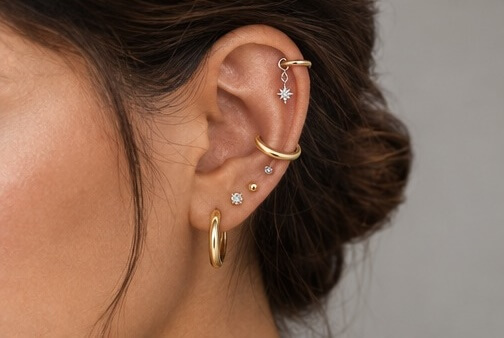
Not sure a helix suits you? Preview it instantly with the AR virtual earring try-on.
Cartilage is firmer, less vascular, and slower to heal. Expect months rather than weeks, and expect a bump at some point during the process. It usually means irritation, not infection.
Helix
The upper outer rim, and the most popular cartilage piercing by a wide margin. Versatile enough for a stud, a huggie or a full hoop, and easy to double or triple into a row. Around 4 to 5 on the pain scale.
Forward Helix
Sits on the small ridge where the rim meets the side of your head, facing forward. Visible head on, which makes it a favorite for people who want their piercings to read from the front rather than in profile. Triple forward helix arrangements are a signature curated ear move.
Flat
Named for the flat plateau of cartilage between the helix rim and the inner folds. It offers the most surface area of any cartilage spot, so it is the natural home for larger charms, clusters and statement studs.
Auricle
The middle of the outer rim, roughly halfway between lobe and helix. Underrated, easy to heal for a cartilage piercing, and useful for bridging the visual gap in a stack that feels top heavy.
Industrial
Two separate cartilage holes connected by one straight barbell, usually running from the forward helix area across to the upper helix. Bold, architectural, and the most demanding piercing on this list to heal, because the bar transmits every knock to both wounds. Requires an ear with the right rim angle, and a good piercer will tell you honestly if yours does not have it.
What Are the Inner Cartilage Piercing Types?
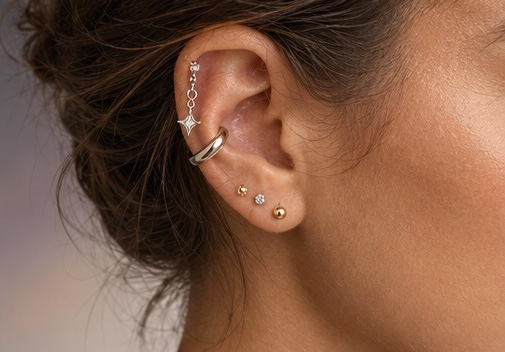
These sit in the folds around the ear canal. They read as intentional rather than default, which is exactly why they anchor most curated ears.
Tragus
The small flap of cartilage covering the ear canal. Compact, flattering on nearly every ear, and surprisingly manageable at around a 5. The main annoyance is pressure from headphones during healing, so over-ear models beat earbuds for the first few months.
Anti-Tragus
The ridge directly opposite the tragus, just above the lobe. Thicker tissue, longer healing, and highly dependent on anatomy. Plenty of ears simply do not have a pronounced enough ridge to hold one safely.
Conch (Inner and Outer)
The conch is the large bowl in the middle of the ear, named after the shell it resembles. An inner conch sits in the center of the bowl and takes a stud. An outer conch sits nearer the rim and can take a large hoop that wraps the whole ear, which is one of the boldest looks available without adding more holes.
Daith
The innermost fold of cartilage directly above the ear canal. It takes a ring rather than a stud, so it frames the inner ear rather than dotting it. You will see claims online about daith piercings and migraine relief; the clinical evidence remains thin, so treat it as an aesthetic choice, not a treatment.
Rook
The thick fold above the daith. Dense tissue means a sharper initial sensation, around a 7, and a healing window that regularly stretches past nine months. It also gives one of the most satisfying profiles in a stack, so people keep signing up for it.
Snug
The inner ridge running parallel to the outer rim, pierced so both ends of a curved barbell show on the same face of the ear. Widely considered the most painful ear piercing, and the most anatomy dependent. Many ears lack a defined enough ridge, and a piercer who offers one anyway is a piercer to walk away from.
Which Ear Piercings Hurt the Most?
Ranked from gentlest to sharpest, based on averaged self-reported studio data:
| Rank | Piercing | Typical Pain | Why |
|---|---|---|---|
| 1 | Standard lobe | 2 | Soft tissue, no cartilage |
| 2 | Upper lobe | 2 to 3 | Still soft tissue, slightly firmer |
| 3 | Auricle | 4 | Thin outer cartilage |
| 4 | Helix | 4 to 5 | Thin rim cartilage |
| 5 | Tragus | 5 | Small but dense flap |
| 6 | Forward helix | 5 | Tight angle, firm tissue |
| 7 | Conch | 5 to 6 | Thicker cartilage plate |
| 8 | Daith | 6 | Deep fold, awkward access |
| 9 | Anti-tragus | 6 to 7 | Dense ridge tissue |
| 10 | Rook | 7 | Thick double layer fold |
| 11 | Industrial | 7 to 8 | Two piercings in one sitting |
| 12 | Snug | 8 | Thickest inner ridge |
Worth knowing: the piercing itself lasts under two seconds. The part people actually find difficult is weeks three through eight, when the site is tender, easily snagged and impossible to sleep on.
How Long Does Each Ear Piercing Take to Heal?
| Healing Window | Piercings | What to Expect |
|---|---|---|
| 6 to 10 weeks | Standard lobe, upper lobe | Mild tenderness for the first fortnight, then quiet |
| 2 to 4 months | Third lobe, transverse lobe | Occasional swelling, easy to snag on clothing |
| 3 to 6 months | Helix, tragus, auricle, forward helix | Irritation bumps are common and usually resolve |
| 4 to 12 months | Conch, daith, flat, anti-tragus | Looks healed long before it is; do not downsize early |
| 6 to 12 months | Rook, snug, industrial | Needs patient aftercare and zero pressure while sleeping |
Three rules that shorten every timeline: sterile saline twice a day and nothing else, implant grade titanium for the entire healing period, and hands off. Rotating jewelry is outdated advice that tears fresh tissue.
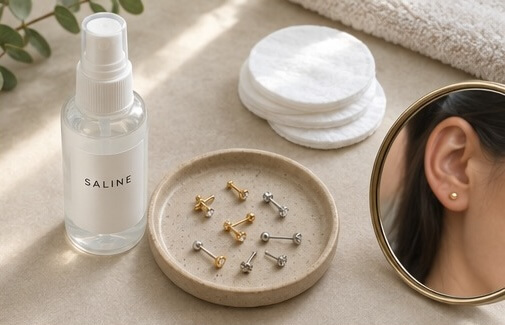
What the Healing Actually Feels Like, Week by Week
| Stage | Cartilage Piercing | What to Do |
|---|---|---|
| Days 1 to 7 | Swelling, warmth, a little crusting | Saline twice daily, sleep on the other side |
| Weeks 2 to 4 | Tenderness settles, crusting continues | Keep hair products and headphones away from it |
| Weeks 5 to 12 | Looks healed, is not healed | Book the downsize appointment, change nothing yourself |
| Months 4 to 8 | Occasional irritation bumps appear and fade | Find and remove the snag source, resist the urge to treat it |
| Months 9 to 12 | Stable, no discharge, no tenderness | Now you can switch to gold and change styles freely |
The most common mistake is treating month three as the finish line. Cartilage heals from the outside in, so the visible surface closes long before the channel inside is stable. Changing jewelry at that point reopens tissue that was almost done, and resets the clock for everyone involved.
Which Piercing Types Suit Your Ear Anatomy?
Your ear, not a generic chart: see which placements actually fit your anatomy in the ear piercing simulator.
This is the part that generic piercing charts get wrong. A chart implies every ear can host every placement. Ears are as individual as fingerprints, and four features decide what is realistically available to you.
| Your Anatomy | Works Beautifully | Usually Off the Table |
|---|---|---|
| Thin, shallow lobe | Single or double lobe, helix, flat | Transverse lobe, heavy hoops |
| Shallow conch bowl | Helix, forward helix, tragus | Inner conch with a long post, large wrap hoops |
| Undefined inner ridge | Daith, conch, helix | Snug, sometimes rook |
| Small or flat tragus | Auricle, helix, lobe stack | Tragus, anti-tragus |
| Straight rim with little curve | Lobe stack, conch, daith | Industrial |
| Deep, well defined folds | Rook, snug, daith, industrial | Very little, lucky you |
A reputable piercer will assess this in person and refuse anything your ear cannot support. Before you get there, AR try-on gives you a preview of how each placement sits on your own ear geometry, so you arrive with a realistic shortlist instead of a screenshot of somebody else's ear.
Try it yourself: open the AR virtual earring try-on and ear piercing simulator and test three placements you have been considering. It takes less time than reading this section did.
How Do You Build a Curated Ear Stack?
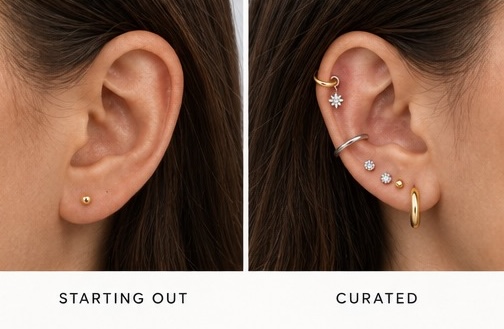
A curated ear is a composition, not a collection. The pieces that make it work are spacing, proportion and a repeating element.
Start With an Anchor
Pick one statement placement, usually a conch or a flat, and build around it. Everything else plays support.
Follow the Rule of Three
Odd numbers read as intentional. Three lobe studs plus a helix plus a conch feels designed. Four evenly spaced identical studs feels like a ruler was involved.
Vary Scale, Repeat Metal
Mix sizes freely, but repeat at least one material or motif across the ear so the eye connects the pieces. Mixed metals work when a single piece bridges both tones.
Respect the Negative Space
The gaps are part of the design. Crowding the rim removes the contrast that makes individual pieces visible.
Build It Over Years, Not Months
Cartilage healing means a realistic curated ear takes two to three years to complete. Plan the full composition first, then add one or two placements per sitting.
Popular combinations worth borrowing:
- Minimal classic: double lobe plus a single helix stud
- Constellation: triple lobe, flat cluster, forward helix
- Bold frame: outer conch wrap hoop, double helix, lobe stud
- Inner focus: daith ring, tragus stud, single lobe
- Full curation: triple lobe, helix, flat, conch, daith, rook
Planning a stack visually before booking is exactly the use case AR try-on was built for, and it is why jewelry retailers now treat the simulator as a merchandising surface rather than a gimmick. If you want a look at how this works in a live storefront, browse Perfect Corp's interactive product showcase.
How Much Do Ear Piercings Cost?
| Piercing | Typical Service Fee (US) | Jewelry (Implant Grade Titanium) | Realistic Total |
|---|---|---|---|
| Lobe (pair) | $20 to $50 | $30 to $80 | $50 to $130 |
| Helix | $30 to $60 | $30 to $120 | $60 to $180 |
| Tragus | $35 to $65 | $35 to $120 | $70 to $185 |
| Conch | $40 to $75 | $40 to $150 | $80 to $225 |
| Daith | $40 to $80 | $45 to $160 | $85 to $240 |
| Rook | $45 to $85 | $45 to $160 | $90 to $245 |
| Industrial | $60 to $110 | $50 to $150 | $110 to $260 |
Studios that quote a suspiciously low all-in price are usually including low grade jewelry, which is the single most common cause of a healing that drags on for a year. Expect to pay for the metal separately at any reputable studio, and expect that to be the right call.
What Jewelry Works Best for Each Piercing Type?
| Jewelry Style | Best Placements | Notes |
|---|---|---|
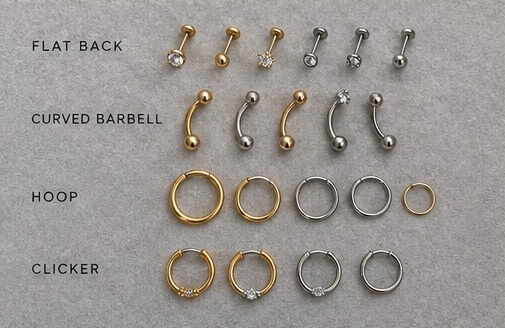
| Flat back labret | Helix, tragus, conch, flat, lobe | The default for healing anything in cartilage |
| Curved barbell | Rook, snug, anti-tragus, transverse lobe | Follows the curve of folded tissue |
| Straight barbell | Industrial, transverse lobe | Needs correct length or it migrates |
| Seamless hoop | Helix, daith, lobe (healed only) | Never as a starter in cartilage |
| Clicker ring | Daith, conch, helix (healed) | Easy to open, holds larger designs |
| Huggie | Lobe, helix | Sits close, low snag risk |
Material rules are simpler than jewelry marketing suggests. Implant grade titanium for anything healing. Solid 14k gold once healed. Avoid plated pieces, mystery alloys and anything sold with a butterfly back for a fresh cartilage piercing.
Why Metal Grade Matters More Than Style
Nickel sensitivity affects a significant share of the population, and a healing piercing is the worst possible place to discover yours. Surgical steel, despite the reassuring name, contains nickel. Implant grade titanium does not, which is why studios that heal cartilage successfully work with it almost exclusively.
Gold complicates things slightly. Solid 14k and 18k are excellent in a healed piercing, but plated gold wears through at exactly the friction points inside a fresh channel and exposes whatever alloy sits underneath. The practical sequence is titanium for healing, solid gold afterwards, plated never in a piercing you care about.
Getting the Size Right
Three measurements decide whether a piece fits: gauge (the thickness of the post, usually 18g or 16g for ears), post length or inner diameter, and the size of the decorative front. Order a hoop 1mm too small and it presses; 2mm too large and it swings and snags. Scale is the hardest of the three to judge from a product photo, which is precisely why AR try-on has become a fixture on jewelry product pages.
What Happens at an Ear Piercing Appointment?
Knowing the sequence removes most of the nerves, and it also tells you quickly whether you have walked into a good studio or a bad one.
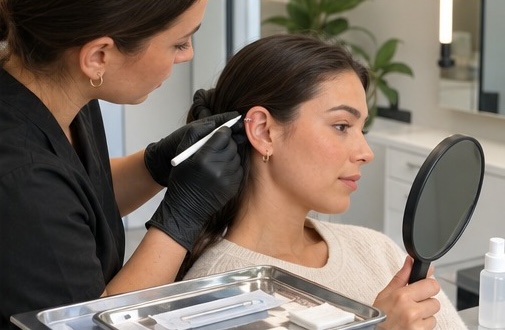
The Consultation
A competent piercer looks at your ear before quoting anything. They check tissue depth, fold definition and the angle of your rim, then tell you which of the placements on your shortlist are viable. If someone agrees to a snug without examining your inner ridge, leave.
The Marking
Placement dots go on with a sterile marker, and you get a mirror. This is the moment to be difficult. Millimeters decide whether a stack looks deliberate or accidental, and a good piercer expects you to ask for adjustments. Arriving with AR screenshots of the composition you want makes this conversation faster and far more precise.
The Piercing
A single use hollow needle, never a piercing gun for anything above the lobe. Guns crush cartilage rather than cutting a clean channel, which is why gun-pierced cartilage heals badly and migrates. The needle itself takes under two seconds per hole.
The Jewelry
Implant grade titanium, threadless or internally threaded, sized long enough to accommodate swelling. You will come back in six to twelve weeks to downsize to a shorter post, and skipping that appointment is how posts end up embedded.
The Aftercare Brief
Sterile saline twice daily, no twisting, no touching, no submerging in pools or baths for the first month. Any studio that hands you an alcohol wipe or a bottle of tea tree oil is working from advice two decades out of date.
What Are the Ear Piercing Trends Right Now?
Placement fashion moves slower than clothing but it does move, and the current cycle favors restraint with one loud note.
- Mixed metals. The rule against combining yellow and white gold is gone. One bridging piece that contains both tones ties the stack together.
- Charm drops on cartilage. Tiny dangles on helix and flat placements, previously reserved for lobes, are now the fastest growing style in curated ears.
- The single statement conch. One oversized outer conch hoop, with everything else kept small, has replaced the maximalist ear of a few years ago.
- Asymmetry on purpose. Matching both ears now reads as dated. Most curated ears treat the two sides as a pair of complementary compositions rather than mirror images.
- Planning before piercing. Virtual try-on has moved from novelty to standard step, both in studio consultations and on jewelry product pages.
Trends aside, the piercings that age best are the ones chosen for your anatomy rather than for a reference photo of somebody else's ear. For more on visualizing placements before you commit, see our guide to the definitive ear piercing chart and simulator.
Which Ear Piercing Should You Get Next?
Use this as a shortcut. Find the row that matches where you are and what you want, and you have your next appointment.
| If You Want | Get This | Why It Works |
|---|---|---|
| Your first piercing ever | Standard lobe | Lowest pain, fastest healing, endless jewelry options |
| Your first cartilage piercing | Helix | Manageable pain, versatile styling, forgiving placement |
| Something visible from the front | Forward helix or tragus | Reads head on rather than only in profile |
| One bold statement piece | Outer conch | Takes a large hoop that frames the whole ear |
| Something subtle but distinctive | Daith | Tucked inside the ear, noticed only up close |
| A high impact addition to an existing stack | Rook or flat cluster | Adds vertical interest where most stacks are flat |
| Maximum jewelry surface area | Flat | Largest cartilage plateau, best for charms and clusters |
| To fill a gap in a top heavy stack | Auricle | Bridges the visual distance between lobe and helix |
One caveat worth repeating: every recommendation above assumes your anatomy supports it. Check the anatomy table earlier in this guide, preview the placement on your own ear, and let your piercer make the final call in person.
How Do Jewelry Brands Use Virtual Try-On for Piercing Decisions?

For jewelry brands: see how AR try-on performs on a live storefront in the Perfect Corp showcase.
The decision path for a piercing is unusually long. Customers research for weeks, save reference images, and still hesitate at checkout because they cannot picture the piece on themselves. That hesitation is the conversion gap, and AR closes it.
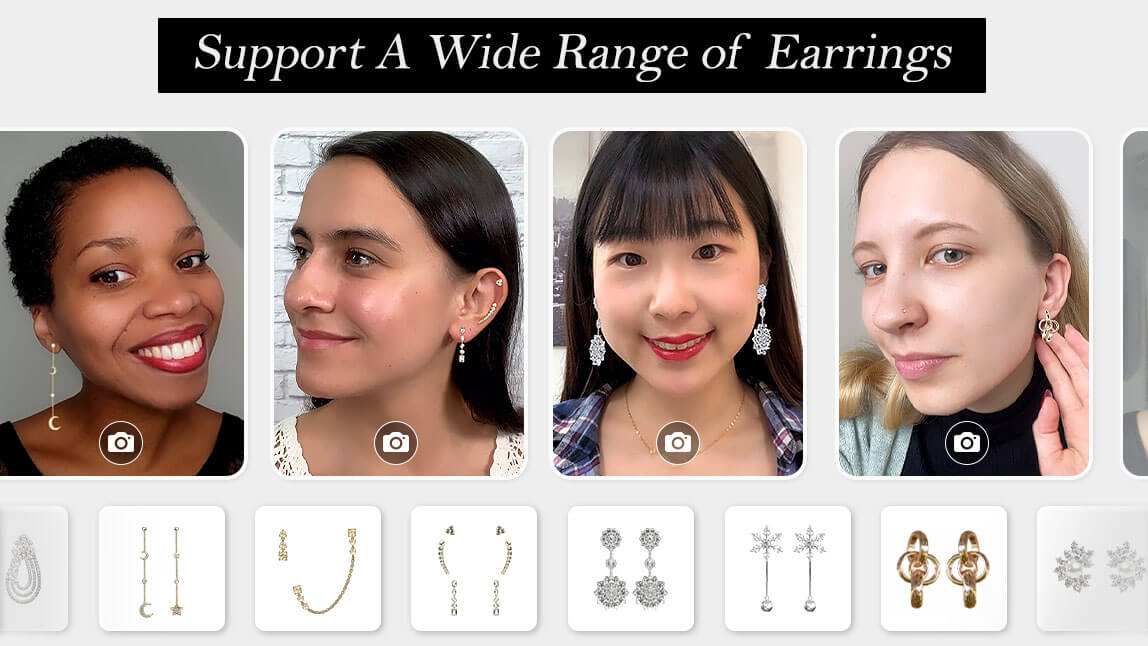
Perfect Corp's AR jewelry technology uses real time facial and ear detection to render earrings and piercing placements onto a live camera feed, with accurate scale, perspective and metal reflection. It runs on web, in app, or on in-store tablets, and it is used by over 800 brand partners across beauty and fashion.
What brands report when they add it:
- Longer product page sessions. Try-on turns a static listing into an interaction, and time on page rises accordingly.
- Higher average order value. Shoppers planning a stack buy multiple pieces in one basket rather than one at a time.
- Fewer returns. Size and scale surprises are the leading cause of jewelry returns, and seeing the piece in place removes most of them.
- Cleaner first party data. Which placements customers test most is genuine merchandising signal, and it costs nothing extra to collect.
Studios and piercing chains use the same technology as a consultation tool, letting clients preview placements on their own ear before the appointment. It shortens consultations and reduces the number of clients who book something their anatomy cannot support.

Book a walkthrough: contact Perfect Corp for a live demo and customized pricing.
Ready to build this into your storefront? Contact Perfect Corp for a demo and a customized pricing plan, or explore the technical documentation in the YouCam AI API Playground if you would rather test the integration yourself first.
FAQ: Types of Ear Piercings
How many types of ear piercings are there?
Around sixteen widely recognized placements, grouped into lobe, outer cartilage and inner cartilage. Piercers occasionally name sub-variations, but sixteen covers everything a studio will realistically offer.
Which ear piercing hurts the most?
The snug, at roughly 8 out of 10, because it passes through the thickest inner ridge of cartilage. The rook and the industrial follow closely behind.
What is the fastest healing ear piercing?
The standard lobe, at six to eight weeks. Every cartilage piercing takes at least three months, and most take longer than the internet suggests.
How many ear piercings can I get in one session?
Most reputable piercers cap it at two or three, and rarely more than one cartilage piercing per ear. Healing competes for the same resources, so stacking too many at once slows all of them down.
Can I sleep on a new cartilage piercing?
Avoid it for the first few months. Pressure during sleep is the leading cause of irritation bumps and migration. A travel pillow with the center hole positioned under your ear is the standard workaround.
Do ear piercings close if I stop wearing earrings?
Lobe piercings can shrink within hours in the first year and stay partially open for decades after that. Cartilage piercings close faster and more completely, sometimes within days even after full healing.
How do I tell an irritation bump from an infection?
An irritation bump is skin colored or pink, painless to mild, and responds to removing whatever is snagging the jewelry. Signs that point elsewhere include spreading heat, throbbing pain, yellow or green discharge and fever, and those warrant a visit to a doctor rather than a piercer.
Does a daith piercing help migraines?
There is no reliable clinical evidence that it does. Anecdotal reports exist, but studies have not supported them. Choose a daith because you like how it looks.
What metal should I get pierced with?
Implant grade titanium, ASTM F136 or equivalent, for the entire healing period. It is nickel free, lightweight and the standard reputable studios work with. Save solid gold for fully healed piercings.
When can I change the jewelry in a new piercing?
Once the piercing is fully healed, not once it feels healed. That means six to eight weeks for lobes and four to twelve months for cartilage. Changing jewelry early is the most common reason a cartilage piercing restarts its healing from zero.
Can I see how piercings would look on my ear before getting one?
Yes. AR ear piercing simulators render jewelry onto a live view of your own ear in real time, so you can test placements, sizes and metal tones before booking. It is free to try and it is the most useful ten seconds in the entire planning process.
Which ear piercings look best together?
Combinations that mix scale and leave breathing room. A triple lobe with a single helix and a conch is the most reliable starting composition. Build around one anchor piece rather than distributing equal weight across the ear.
Whichever placements you land on, plan the composition before the needle. Map the anatomy, check the pain and healing realities, then preview the whole stack on your own ear so the only surprise on appointment day is how quickly it is over.